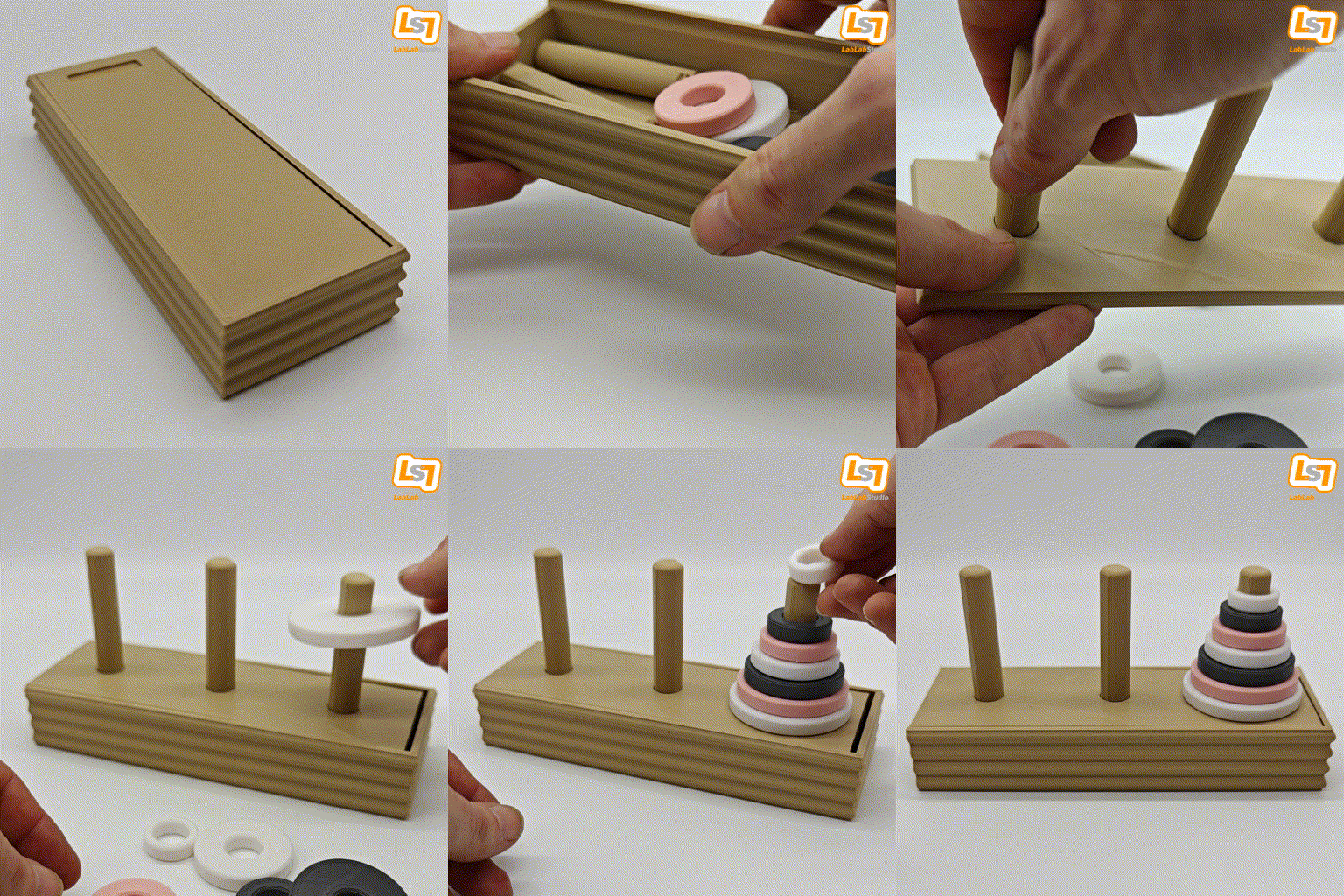
3D model description
The game is truly the best method of development and learning. After solving a 3-level tower in front of my 6-year-old son, he solved a 5-level one.
Why did I model my own puzzle instead of downloading one from the many available online?
Because he is 6 years old, tends to lose pieces of his toys easily, can be a bit rough, and delicate toys don’t last long. So, I needed something sturdy and easy to store. I opted for detachable columns printed horizontally. If you want to know why printing horizontally makes objects more robust, check the print settings.
The game’s rules. I have recorded a video showing the solution for a 4-level tower.
If you want to print and sell these objects, you can obtain a commercial license for only €1 here. This license applies to all my creations.
IMPORTANT: These files are protected by copyright even though they are free. You cannot resell or distribute them for free.
In this download, you will find a puzzle with its storage box, which you are not obligated to print, of course. The columns are easy to assemble. There is a 7-level tower and another one with 12 levels.
This puzzle can be resized without any issues. At 50%, you have a travel-sized puzzle.
Bonus: an additional brain teaser. The 7-level tower AND the 12-level tower can be stored in the same box (from 100% to 53%, it doesn’t work at 50%).
Feel free to post a make; your creations always inspire me.
You can find all my models here
And other puzzles here
including this one


My free models
3D printing settings
Very easy and support-free printing. Can be resized without any issues. Shrunk down to 50%, enlarged as much as you want (but less interesting).
For a 50% print: a layer height of 0.2mm is recommended. Additionally, for the washers (levels/floors), you will need to print at 53% in X and Y, and 50% in Z.
For a print at 53% and beyond: a layer height of 0.28mm works very well. All parts are to be printed with the same size.
Why print the columns horizontally?
3D printing by filament deposition leads to a weak bond between layers. Breaks will occur first between the layers. It is easy to understand that the greater the ratio between height and surface area of the piece, the more fragile it is. Typically, a vertically printed column will break very easily in case of a fall or strong stress. On the other hand, if you print the column horizontally, the height/surface ratio is low, and the piece is stronger. In reality, the column is almost unbreakable.
That’s why it is often preferable to change the orientation of a piece when printing, to gain in robustness. In this case, you don’t have to do anything; all the pieces are already oriented as you should print them.